Database strategies
Rules and models
Historical race, runner and price data feeds a maintained database and feature layer. Each rule-based or machine-learning-assisted strategy has its own evidence, status and price limits.
Governed decision system
Value Bet Edge turns UK and Irish horse-racing data into testable strategies, published candidates, controlled small-stakes execution and measurable results.
It is a working example of models, AI agents, external automation and human judgement operating as one accountable system.
The problem
Finding a promising pattern is only the start.
A usable system must collect reliable data, apply the same rules every time, control the route to action, reconcile the result and show when the evidence is weakening.
Without that operating loop, research becomes a collection of interesting backtests. Rules drift. Results become difficult to compare. Weak strategies can remain active because nobody has defined when to review them.
Adding AI without maintained context, tests and execution limits would only automate the uncertainty.
The system
I built Value Bet Edge as a repeatable research and decision pipeline rather than a single prediction model.
Database strategies
Historical race, runner and price data feeds a maintained database and feature layer. Each rule-based or machine-learning-assisted strategy has its own evidence, status and price limits.
Experimental evidence lane
PieAI is a Hermes agent running independently on a Raspberry Pi 5. Although it runs on a different machine, it uses the same shared data and maintained knowledge base as the wider system. Its role and route to action remain bounded.
PieAI builds a morning map of the full card and rechecks promising favourites and near-favourites close to the off. It publishes only when the runner, market, price, race stage and supporting evidence still meet the rules.
The lanes remain separate. PieAI cannot borrow the published track record of the database strategies. Betfair Bot Manager applies the final price and staking rules, then records whether each candidate was placed or skipped.
The workflow
Every step has a clear input, output and owner.
Collect racecards, historical results, settlement prices and runner data.
Update the database and the maintained feature layer.
Run each statistical strategy under its frozen rules.
Let PieAI build a market map and monitor its strongest candidates.
Recheck current evidence before a candidate is published.
Write approved rows to a small machine-readable feed.
Let Betfair Bot Manager apply the final execution and price controls.
Remove stale rows, reconcile results and review strategy drift.
The operating model
Tools alone do not create a trustworthy decision.
I decide what is worth testing, what counts as good evidence and when a strategy must be reviewed or stopped. The system cannot set its own risk tolerance or quietly redefine success.
AI agents interrogate the data, test ideas, assemble the market map and monitor exceptions. PieAI can research, recheck and publish a qualifying candidate, but it cannot bypass the execution gates.
The database, frozen strategy rules, tests, ratings, price movement, race evidence, limits, results and decision notes give every run current structured context.
Each strategy remains identifiable by its method, maturity and limits. Late checks, price gates, atomic updates, audit records and stale-row removal keep the decision path inspectable.
Visible evidence
The evidence stays public, including drawdowns, losing runs and strategies under review.
strategy families
races
runners
published rows
settled results
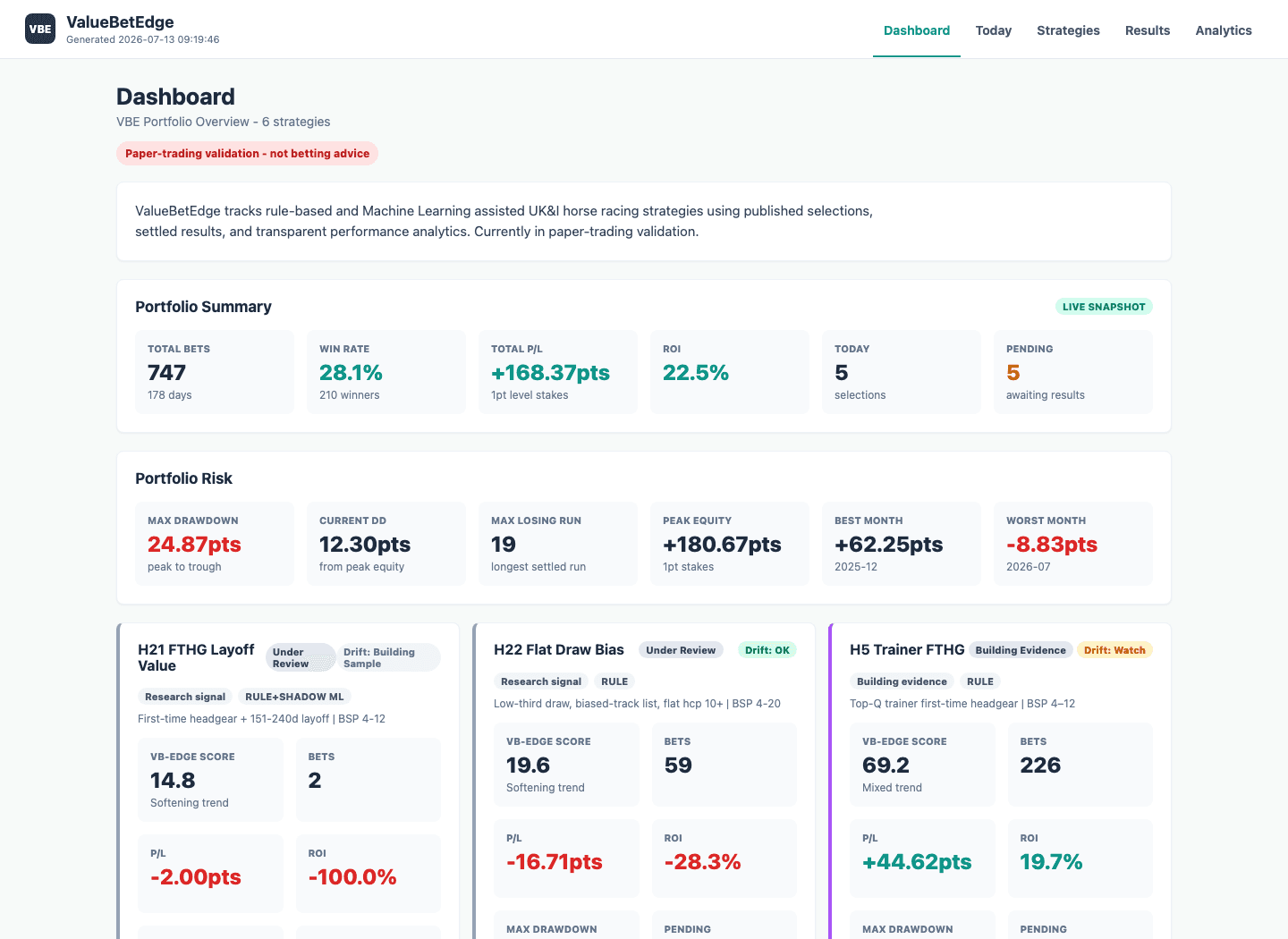
The public performance record does not claim that every displayed selection was matched at the displayed stake or that past results will continue. Betting involves risk. This work is shown as operating-system evidence, not betting advice.
Governance in practice
H22 Flat Draw Bias is currently in a negative run and marked for review before any increased exposure.
The system does not hide the loss, rewrite the historical rule or switch the strategy off because of one uncomfortable period. It compares the current run with the model's expected variance and automated drift tests.
The current drift status remains within tolerance, so the evidence supports continued observation rather than a silent rule change. The decision and its reason remain visible.
Analytics and drift
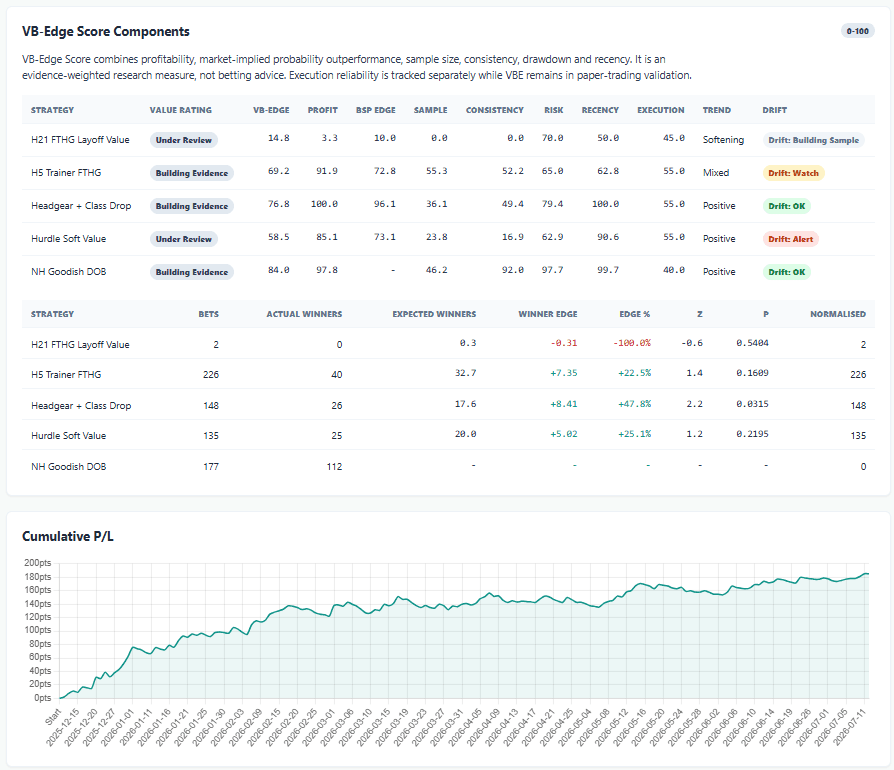
The analytics view keeps profitability, market outperformance, sample size, consistency, drawdown, recency and execution evidence separate.
Strategies can be building evidence, under review, stable or showing a drift warning. They are not presented as equally mature.
What this proves
A model or AI agent becomes useful only when it sits inside an operating system.
Value Bet Edge connects messy data, specialised agents, maintained context, decision rules, external tools, evidence, logs and human control.
It demonstrates two useful roles for AI. Agents can help build and test statistical models. They can also orchestrate a bounded, multi-source decision workflow. In both cases, the output still needs a definition of good, a controlled route to action and evidence coming back from the result.
The same pattern applies to business workflows where a recommendation must be traceable, measured and safe enough to act on.
What I learned
Current state
The public results are calculated as paper-trading validation at one-point level stakes. In parallel, the same operating chain uses controlled small stakes through Betfair Bot Manager so execution is realistic and placements, skips and results can be captured.
PieAI remains a separate experimental lane. Its performance is tracked inside Betfair Bot Manager and is not included in the published database-strategy record. This proves the operating system runs. It does not prove every strategy is profitable or ready to scale.
Next step
I can help you map the data, agent roles, rules, maintained context, tests, automation and human gates around one real workflow.