Local variables
<ClientName><SourceAI><Project>Run-specific information supplied when the workflow starts.
Live product proof
Design Your Prompt is a live product for designing multi-step prompt workflows, testing them with changing inputs, sharing maintained methods with a team and exporting proven workflows as Claude Skills.
It moves useful AI work out of private chat histories and into a process that can be inspected, reused and improved.
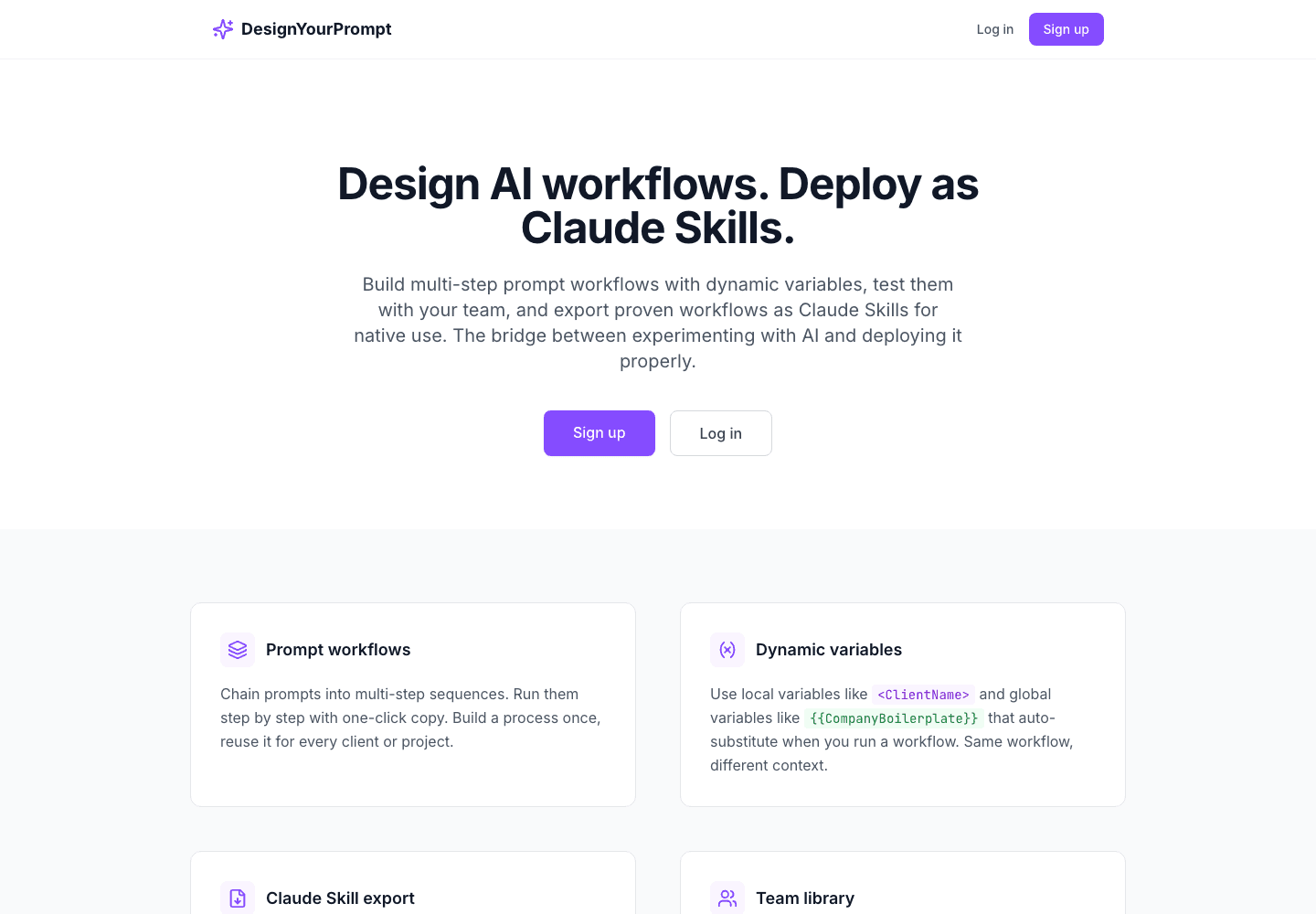
hosted product
beta users given access
not a prompt folder
deployment route
The problem
People often use AI through isolated chat sessions.
They rewrite the same background, paste the same instructions and solve the same setup problem repeatedly. Useful methods stay inside one person's chat history.
A prompt library only solves part of the problem. Real work often needs several steps, changing inputs, reusable company context, testing and a route into the tools people already use.
Without that system, the team has prompts but not a repeatable method.
What I built
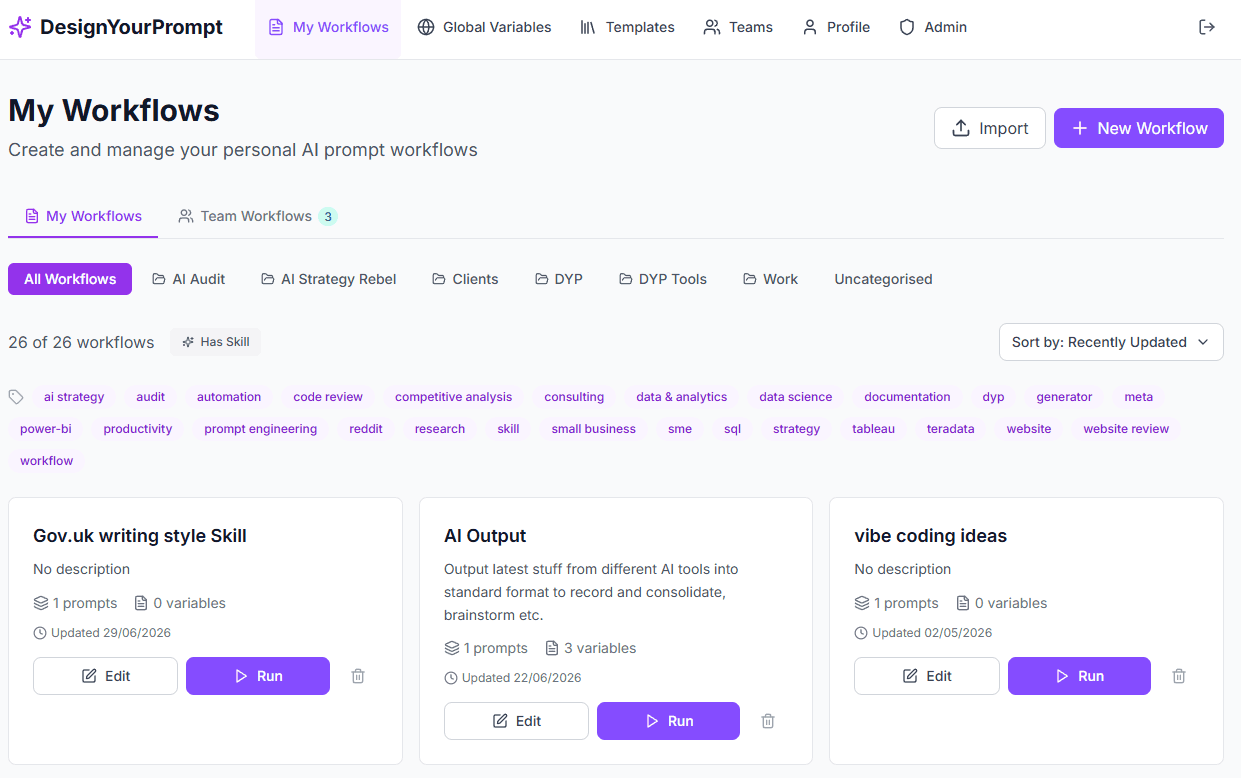
A user can chain prompts, define variables, test with real values and refine weak steps before sharing or exporting the method.
Multi-step workflows
Local and global variables
.dyp.json import and export
AI workflow generation
Folders, tags and templates
Team libraries
Administrative publishing
Usage statistics
Claude Skill export
Two types of context
The method stays stable while the inputs change. That is what turns a one-off prompt into a reusable process.
<ClientName><SourceAI><Project>Run-specific information supplied when the workflow starts.
{{CompanyBoilerplate}}{{WritingStyle}}{{OperatingContext}}Reusable team or company information available across workflows.
The workflow
Every stage makes the method more visible and less dependent on private memory.
Define the outcome and what useful output looks like.
Break the method into the steps needed to reach that outcome.
Write each prompt as part of a sequence.
Replace changing information with local variables.
Store reusable company or team context as global variables.
Run the workflow with real values.
Review the output and refine weak steps.
Save and organise the tested workflow.
Share it with a team or export it as a Claude Skill.
Improve the maintained version instead of keeping private copies.
From experiment to deployment
Design Your Prompt can generate a SKILL.md file from a tested workflow. That file can be added to a Claude Project so the method runs natively inside an agent environment.
The value is not one-click generation by itself. The value is exporting a method that has already been structured and tested.
The operating model
A workflow is only as reliable as the people, agents, context and controls around it.
The user defines the outcome, designs the method, approves the context and judges whether the output is useful. Repeatability does not remove responsibility.
AI models perform the workflow steps. AI-assisted generation can create a starting structure. Exported Claude Skills let a tested method run without asking an agent to invent the process again.
Local variables hold changing run information. Global variables hold maintained company or team context. Steps, folders, tags, templates and team libraries preserve the method.
The sequence is visible, variables are explicit and users can test with real values before sharing or exporting. This is practical workflow governance, not enterprise compliance.
This is practical workflow governance. It is not a claim of formal version control, enterprise approval flows, automated compliance or guaranteed output quality.
A real workflow pattern
A portfolio-summary workflow replaces a repeated manual setup with one maintained sequence.
Those variables can change on each run. The method for extracting, structuring and comparing the information does not.
Reusability does not come from freezing every word. It comes from keeping the method stable while making the changing context explicit.
Evidence
The public product offers sign-up and login. Authenticated users can create and store workflows, organise them with folders and tags, use local and global variables, access team workflows and export Claude Skills.
Eight beta users have been given access. This is evidence of a working product and an initial external test group. It is not a claim that all eight are recurring active users.
The owner workspace and portfolio-summary example show real use beyond an empty product shell.
The evidence does not yet prove quantified business outcomes, sustained team adoption or willingness to pay.
What this proves
Design Your Prompt demonstrates the value of the method around the model: the sequence, maintained variables, testing process, shared context and route from experiment to agent deployment.
It shows that I can move from an observed workflow problem to a live product with accounts, stored data, collaboration and a practical export into an agent environment.
People define and judge the method. Agents perform bounded steps. Context is maintained and reused. Governance makes the process visible and testable before it is shared.
What I learned
Current state
Design Your Prompt is live and usable. It has authentication, stored workflows, team access, variables, import and export, administrative tools and Claude Skill export. Eight beta users have been given access, and I use it for repeatable work.
The product has no revenue yet. It has not proved sustained team adoption or a paid model. The next question is which buyer and use case value maintained workflows, shared context and Skill export enough to adopt and pay for them.
Next step
I can help turn it into a repeatable workflow with maintained context, visible steps, practical tests and human control.